Kim Possible: The Sony Pictures Hack, Twelve Years Later
Twelve years ago a crew called the Guardians of Peace wiped Sony Pictures over a comedy, and half the industry said North Korea was impossible. A Timewarp on the fake personas, the wiper and the programmer with a day job.
Hello there cyber fanatics!
On Monday, November 24th, 2014, people at Sony Pictures came to work, turned on their computers and got a red skeleton instead of a login screen. "Hacked By #GOP." A sound file played gunshots and a scream. The message on the screen said: "We've already warned you, and this is just a beginning."
They were right about the beginning part. Twelve years later the crew behind that skeleton is still working, and the man US prosecutors charged for it is still on the FBI's wanted list.
This is a Timewarp post, so let's go back and meet the crew.
First, What Happened?
If you were not around for this one: Sony Pictures Entertainment is the Hollywood movie studio owned by Sony. In late 2014 it was about to release "The Interview," a comedy about two journalists who are sent to assassinate North Korea's leader, Kim Jong Un. North Korea was not a fan of the plot.
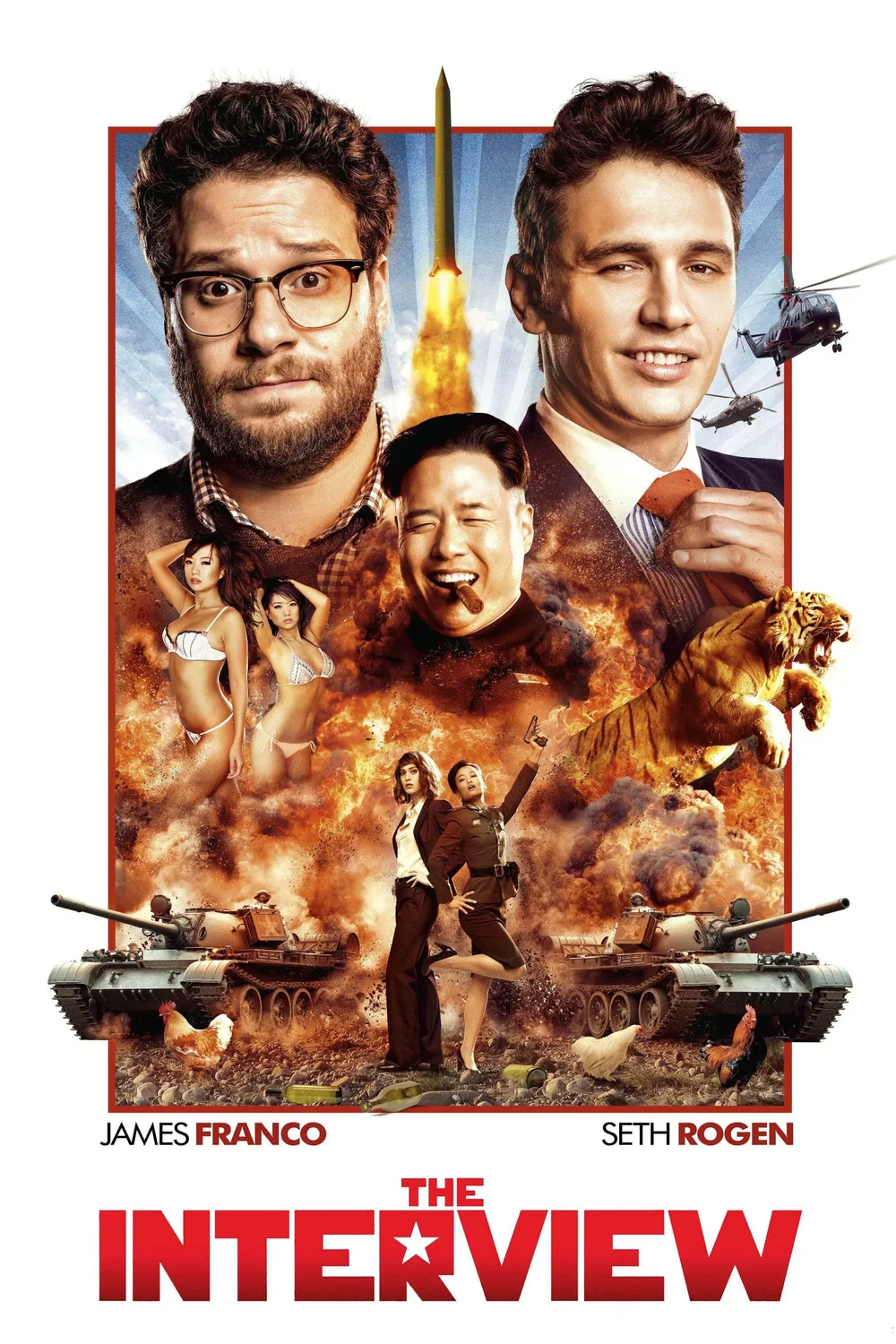
The Interview poster. Image: Sony Pictures / Columbia Pictures.
A crew calling itself the Guardians of Peace, GOP for short, broke into Sony's network, stole a lot of data and then ran a wiper. A wiper is malware that destroys data. There is no ransom note and no decryptor, because the whole point is the damage. After that the crew leaked unreleased movies, executives' emails and employees' personal information, and threatened anyone who would show the film.
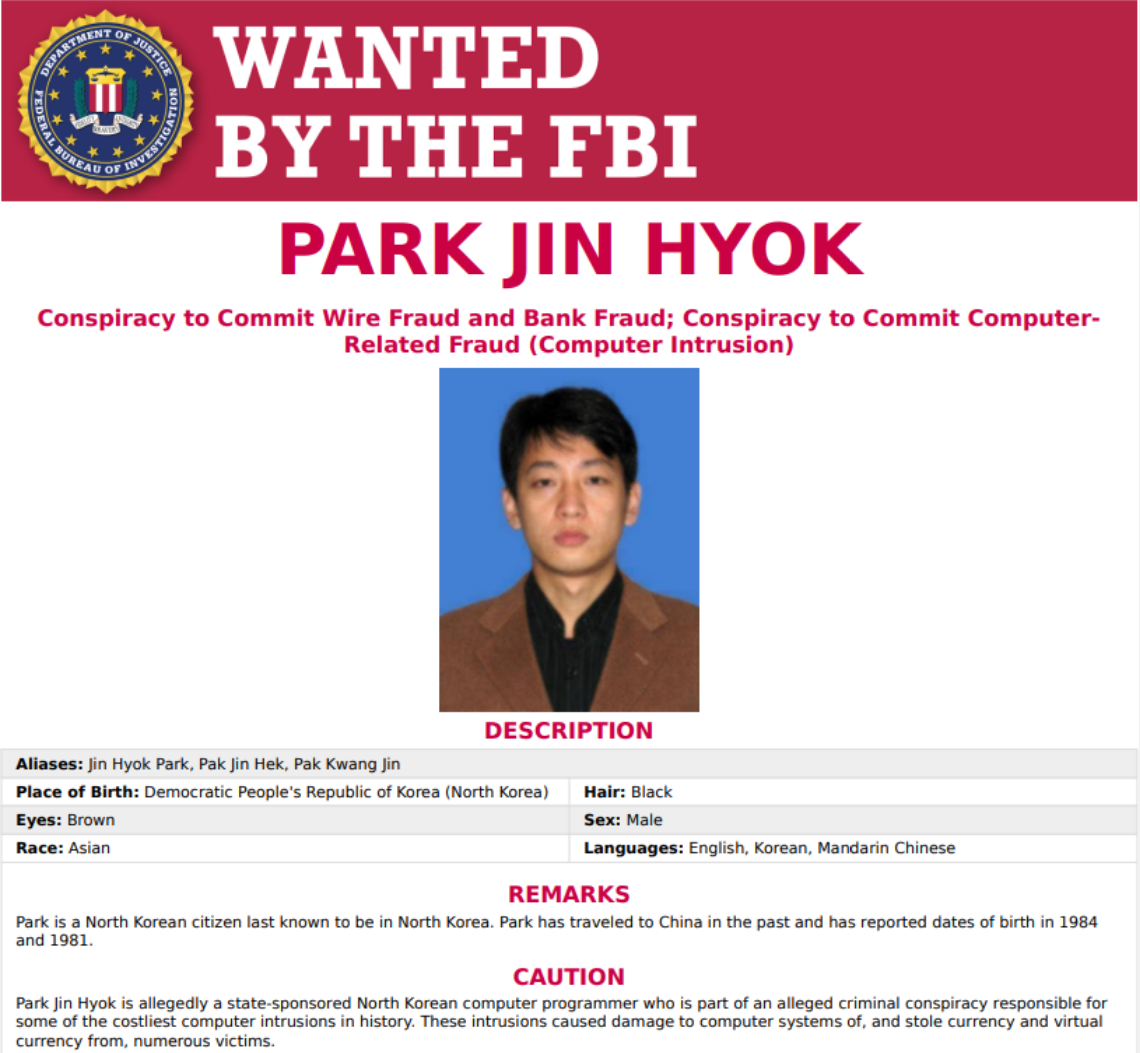
In December 2014 the FBI said the North Korean government was responsible. In 2018 the US Department of Justice (DOJ) charged a North Korean programmer named Park Jin Hyok. Most of the good stuff in this post comes from that 2018 criminal complaint, which is long and very nerdy, in the best possible way.
Extortion or Revenge?
Here is the part I find the most interesting. The GOP did not start with the movie.
Three days before the skeleton, on November 21st, 2014, Sony executives got an email titled "Notice to Sony Pictures Entertainment Inc." It asked for "monetary compensations" and said: "Pay the damage, or Sony Pictures will be bombarded as a whole." It was signed "God'sApstls."
No movie and no Kim Jong Un. It reads like a demand from a regular cybercrime gang. Their first message about the movie came on December 8th, in a GOP post on GitHub: "Stop immediately showing the movie of terrorism which can break the regional peace and cause the war." On December 16th they threatened audiences at the theaters and told everyone to "Remember the 11th of September 2001." The big theater chains backed out, and on December 17th Sony cancelled the Christmas release. A week later it changed its mind, and on Christmas Day the movie opened in about 300 independent theaters and online.
So let me restate the GOP position the way they presented it. We are the Guardians of Peace, and we would like some monetary compensation, and also please stop the movie of terrorism because it breaks the regional peace, and here are your unreleased films for free on a Facebook page, and here is your staff's private data on GitHub, and your employees should sign a letter against their own company or their families are in danger, and if anyone shows the comedy, remember 9/11. All in the name of peace, of course.
Today a state crew wearing a criminal costume is a normal Tuesday. In 2014 it confused a lot of people, and that confusion is a big part of why so many refused to believe the attribution.
The Wiper
Researchers named the malware Destover. I am no reverse engineer, so for this part I am going with the US-CERT alert from December 2014 and the DOJ complaint.
- It spread through Windows file sharing (SMB, Server Message Block) by brute forcing passwords.
- It used a commercial driver that gives programs raw access to the disk, and it overwrote the master boot record (MBR), the first thing a computer reads when it starts. On servers it also overwrote the master file table, so the FBI could not fully rebuild what was there.
- One component had about 10,000 Sony hostnames written into it. Somebody spent a long time inside the network making that list before anyone pressed the button.
- There were also nine scripts for Unix and Linux machines, so nobody got to feel safe.
According to the complaint, Sony disconnected between 7,500 and 8,000 workstations.
And the way in? The complaint points to an email from September 25th, 2014, two months before the skeleton. It carried a OneDrive link to a file called "Advertising Video Clips (Adobe Flash).exe," and the FBI says it likely gave the crew access to Sony's network. A fake Flash video. If you worked in IT in 2014, you just felt something.
Was It Really North Korea?
In December 2014 a lot of people in our industry did not buy it. There were theories about hacktivists angry at Sony's anti-piracy lawsuits, and one security company briefed the FBI on a laid-off former employee. At the end of December, Dark Reading was still asking whether it was North Korea, hacktivists, an ex-employee or all of them together. The idea that North Korea pulled this off was, for many, kim-possible. Sorry. I had to.
On December 19th, 2014 the FBI gave three reasons: the wiper had links to malware North Korean actors built before, the attack used IP addresses tied to known North Korean infrastructure, and the tools looked like the March 2013 attack on South Korean banks and media.
The GOP answered the next day on Pastebin: "The result of investigation by FBI is so excellent that you might have seen what we were doing with your own eyes." Then, "FBI is the BEST in the world," and a link to a YouTube video called "you are an idiot," which they called "the gift for FBI." Very mature, and as it turned out, also wrong.
On January 7th, 2015, the FBI Director added one more detail. The crew used proxy servers in nearly every case to hide where they came from, but "several times they got sloppy." They connected directly from "IPs that were exclusively used by the North Koreans." By then the US had already answered with new sanctions, signed on January 2nd, 2015, that named North Korea's main intelligence agency, the Reconnaissance General Bureau.
Then, in 2018, the complaint showed the receipts. And the receipts are about personas.
Persona Management 101
Before the attack, the crew built fake people.
- Andoson David posted on actors' Facebook pages in September 2014 with a short link and the text "Nude photos of many A-list celebrities." The link led to malware.
- Watson Henny posted the same link. The same account later held 17 email addresses at Mammoth Screen, a British production company that was making a TV drama set in North Korea, and a matching LinkedIn profile sent five of them invites.
- Yardgen tested a fake Facebook login alert addressed to an actor.
Each persona looks fine on its own. The problem is what sits behind them. According to the complaint, one Gmail account was the backup email for Watson Henny, subscribed to the Andoson David page, was used from the same computer as Yardgen on the same day, and was also used by another persona, "Kim Hyon Woo." That account connected to an account in Park's real name at his employer.
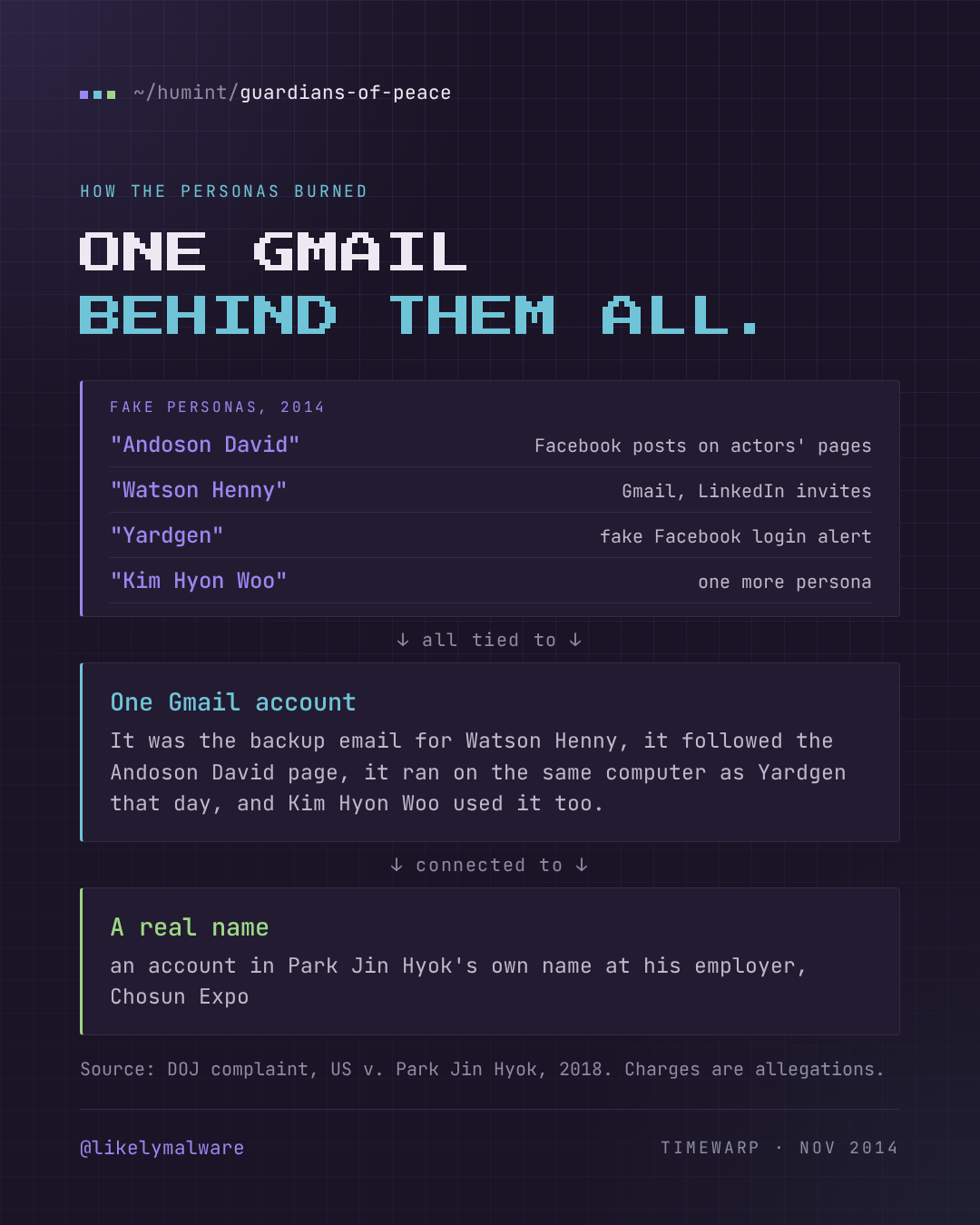
When you talk to threat actors for a living, this is the first thing you learn about personas: they usually burn on something boring, like a recovery email, a reused laptop or one login without the VPN. It is the same way forum criminals get unmasked every year: an old handle, a reused email, a single slip. The North Korean crew had a whole government behind it and still made the forum mistake.
A Programmer With a Day Job?
This is the business part, and it is my favourite.
According to DOJ, Park worked for more than a decade at a company called Chosun Expo Joint Venture, also known as Korea Expo Joint Venture. It had offices in China and North Korea, and DOJ calls it a front company affiliated with Lab 110, a North Korean military intelligence unit. The complaint says he worked there since at least 2002 and spent time in Dalian, China. And the team also did ordinary programming for paying clients, separate from the hacking.
So picture the org chart. A software shop with real customers and real deadlines, and in the same company, a team that wipes a Hollywood studio. I run a research team, and the hardest thing about running two very different kinds of work with one group of people is the context switching. They seem to have handled it.
It also looks to me like an early version of a model that is very alive today. In June 2025, DOJ announced actions against North Korean IT workers who used stolen and fake identities to get remote jobs at more than 100 US companies, with "laptop farms" searched in 16 states. The work is real, the clients are real, and the salaries go back to North Korea. Chosun Expo was doing the office version of that more than ten years earlier.
Same Crew, New Costume?
The name most of us use for this crew today, Lazarus, took hold in February 2016 with a joint industry report called Operation Blockbuster. That is a very good name for a movie studio case.
Look at what came next from the same North Korean hacking program, according to DOJ and the FBI:
- February 2016: $81 million stolen from Bangladesh Bank, using fraudulent SWIFT messages (SWIFT is the network banks use to send payment orders to each other).
- May 2017: WannaCry, the ransomware worm that hit hundreds of thousands of computers and badly hurt the UK's National Health Service.
- February 2021: DOJ indicted Park again, now with two more alleged members of North Korea's military intelligence, for trying to steal and extort more than $1.3 billion in cash and cryptocurrency. The head of DOJ's National Security Division called them "the world's leading 21st century nation-state bank robbers."
- February 2025: the FBI said North Korea was behind the theft of about $1.5 billion in crypto from the exchange Bybit.
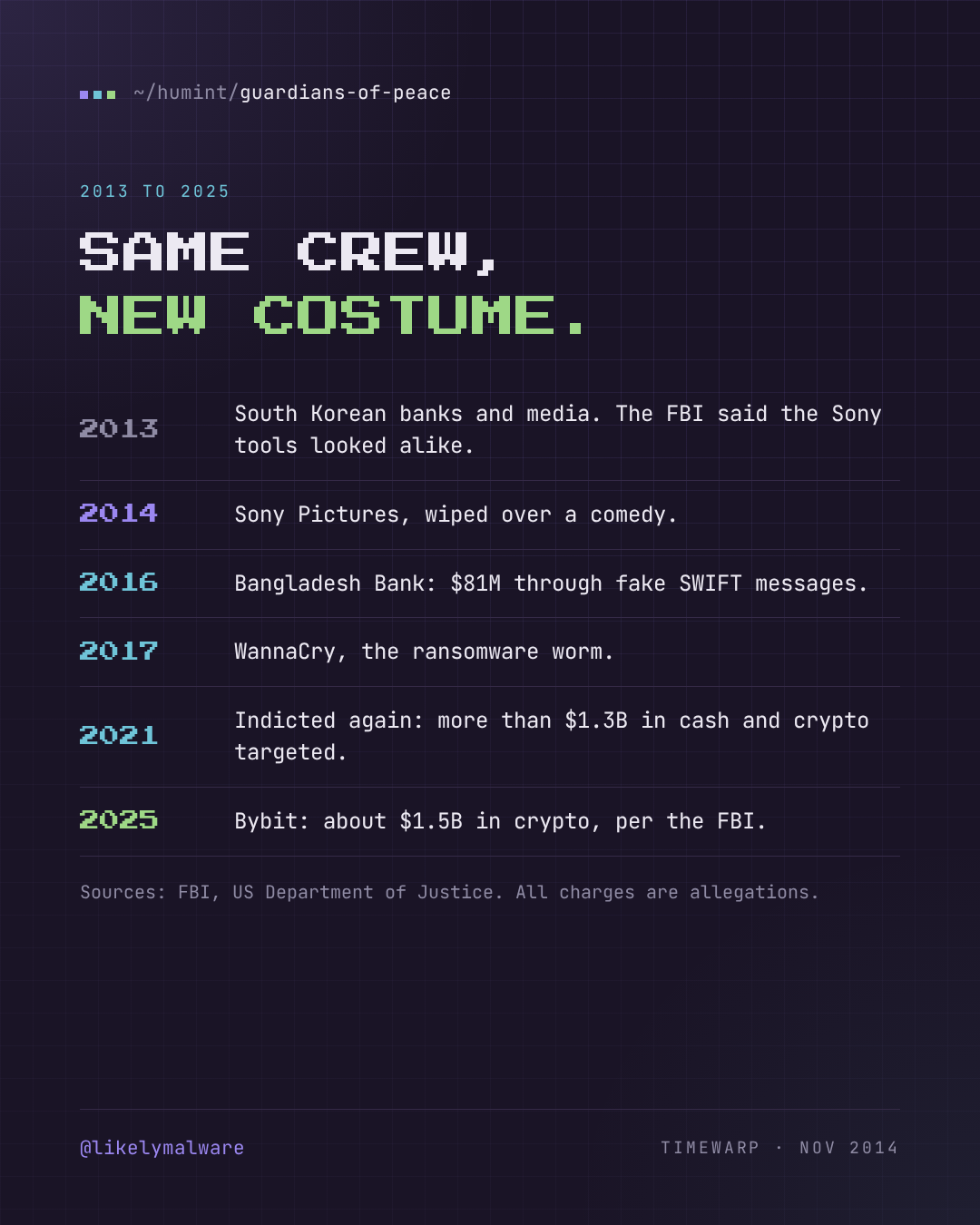
Revenge over a comedy in 2014, bank robbery in 2016, ransomware in 2017, crypto exchanges today. The target moved every time the money moved, and the same program kept showing up behind it. This is exactly what I mean when I say the circle doesn't break.
Why Is He Still on the Poster?
Park is a North Korean citizen, and the FBI says he was last known to be in North Korea. The poster also says he has traveled to China in the past. The US has no extradition with North Korea, so the charges sit there, and so does he.
All of this is an allegation. Park has never faced these charges in court, and he is presumed innocent until proven guilty.
What Can You Take From It?
Three things I would take back to a team today.
- Watch the gap. The fake Flash file landed in September and the wiper ran in November. Ask how long a stranger could sit in your network before anyone noticed, because that is the window you actually have.
- A wiper does not negotiate. There is no ransom to pay and no key to buy. Your only plan is backups the attacker cannot reach and a real process for rebuilding thousands of machines at once.
- If your team uses research personas, read the complaint. The sections about the accounts are the best free training on persona hygiene you will find, written by the people who caught the mistakes.
Twelve years on, the skeleton is gone, the movie is a streaming footnote, and North Korea's hackers steal crypto by the billion. My prediction: Park's poster will still be up when someone writes the fifteen-year version of this post, and the crew will have a new costume by then, unfortunately.
I hope I was able to improve 0.1% of your knowledge. Have fun, and good luck!
Sources
- US Department of Justice, North Korean Regime-Backed Programmer Charged With Conspiracy to Conduct Multiple Cyber Attacks and Intrusions, Sep 6 2018
- US v. Park Jin Hyok, criminal complaint and affidavit, C.D. Cal., filed Jun 8 2018
- FBI, Update on Sony Investigation, Dec 19 2014
- US-CERT (now CISA), Alert TA14-353A, Targeted Destructive Malware, Dec 19 2014
- Fortune, on the GOP message posted to GitHub, Dec 8 2014
- Fortune, on Sony cancelling the Christmas release of The Interview, Dec 17 2014
- CBS News, Sony hackers appear to mock FBI in new message, Dec 20 2014
- NPR, The Interview gets nationwide theatrical release, Dec 25 2014
- Dark Reading, on the competing theories about who hacked Sony, Dec 30 2014
- Just Security, text of the FBI Director's remarks at Fordham University, Jan 7 2015
- US Treasury, testimony on Executive Order 13687 and the North Korea designations after the Sony attack, Jan 13 2015
- Threatpost, Operation Blockbuster coalition ties destructive attacks to Lazarus Group, Feb 24 2016
- NPR, Justice Department charges 3 North Korean hackers for global cyberattacks, Feb 17 2021
- FBI wanted poster for Park Jin Hyok (copy published by DOJ with the Feb 17 2021 release)
- FBI, North Korea responsible for $1.5 billion Bybit hack, PSA I-022625-PSA, Feb 26 2025
- BleepingComputer, US disrupts North Korean IT worker "laptop farm" scheme in 16 states, Jul 1 2025