Ransomware With a Press Office
Seven years since Maze turned a ransomware crew into a newsroom. A Timewarp on the crew that emailed journalists, ran a leak site with press releases, and adopted the word cartel.
Hello there cyber fanatics!
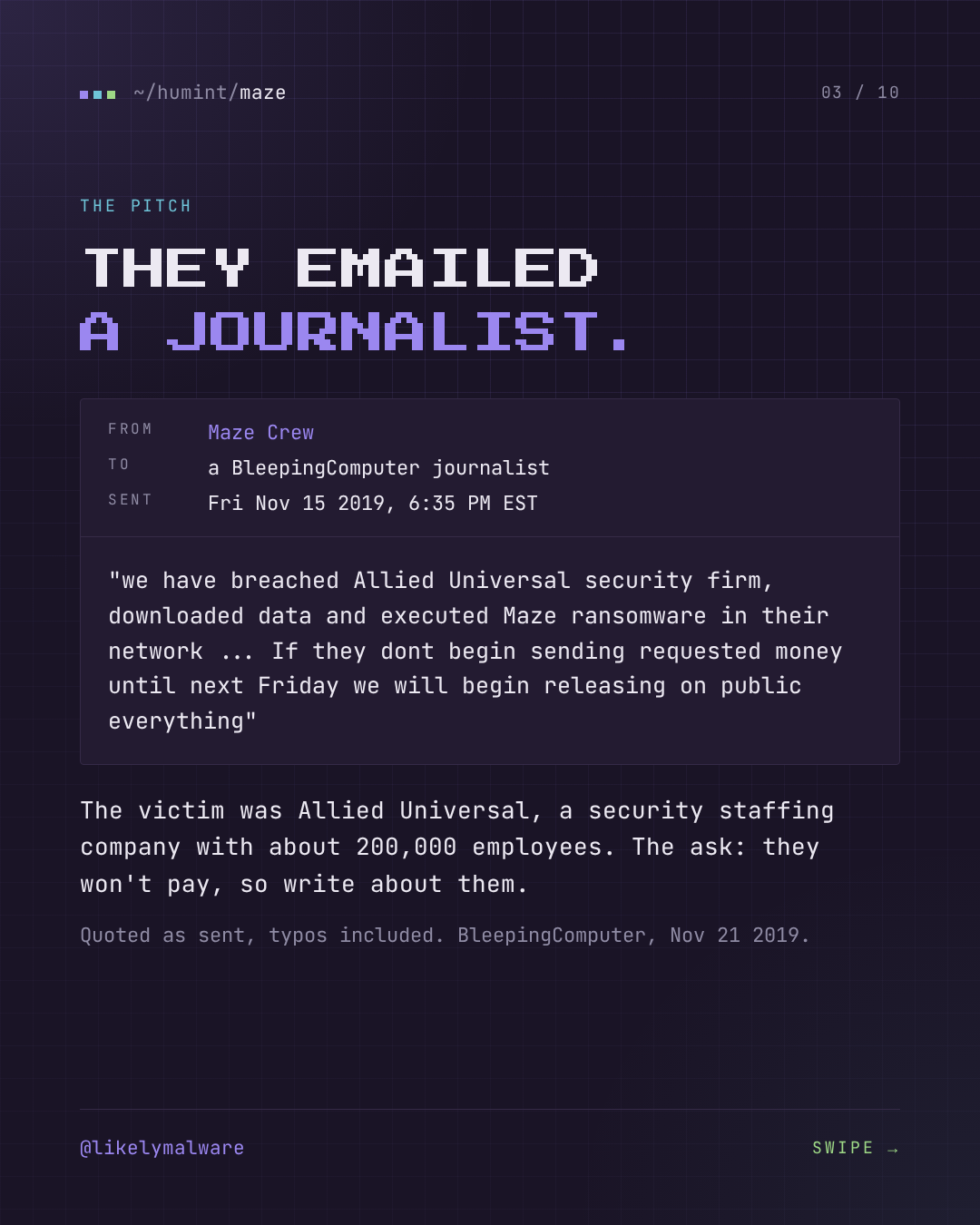
On Friday, November 15th, 2019, at 6:35 PM Eastern, a ransomware crew sent an email to a journalist. It was signed "Maze Crew," it came with a sample of stolen files, and it had a very specific request. If the victim does not pay, please write about them.
That email is one of my favourite artifacts in ransomware history.
Maze is usually remembered as the crew that invented double extortion. I think that undersells them. Maze understood that a ransom note is a private letter, and private letters are easy to ignore. A headline is much harder to ignore. So they built a press operation, with a news site, "press releases" and journalists in their contacts, and ran ransomware like a PR shop.
So this one is about the crew. Let's go.
Who Was Maze?
Maze showed up in May 2019. Researchers first called it ChaCha, after the cipher it used to lock files (ChaCha20, wrapped in RSA-2048). The Maze name stuck soon after.
The first version was spray and pray. It came through exploit kits like Fallout and Spelevo, abusing old Flash Player bugs, and through malicious Word and Excel attachments. It wanted as many machines as possible, home users included. When the master keys leaked in 2022, nine of them belonged to that original consumer version, which tells you where they started.
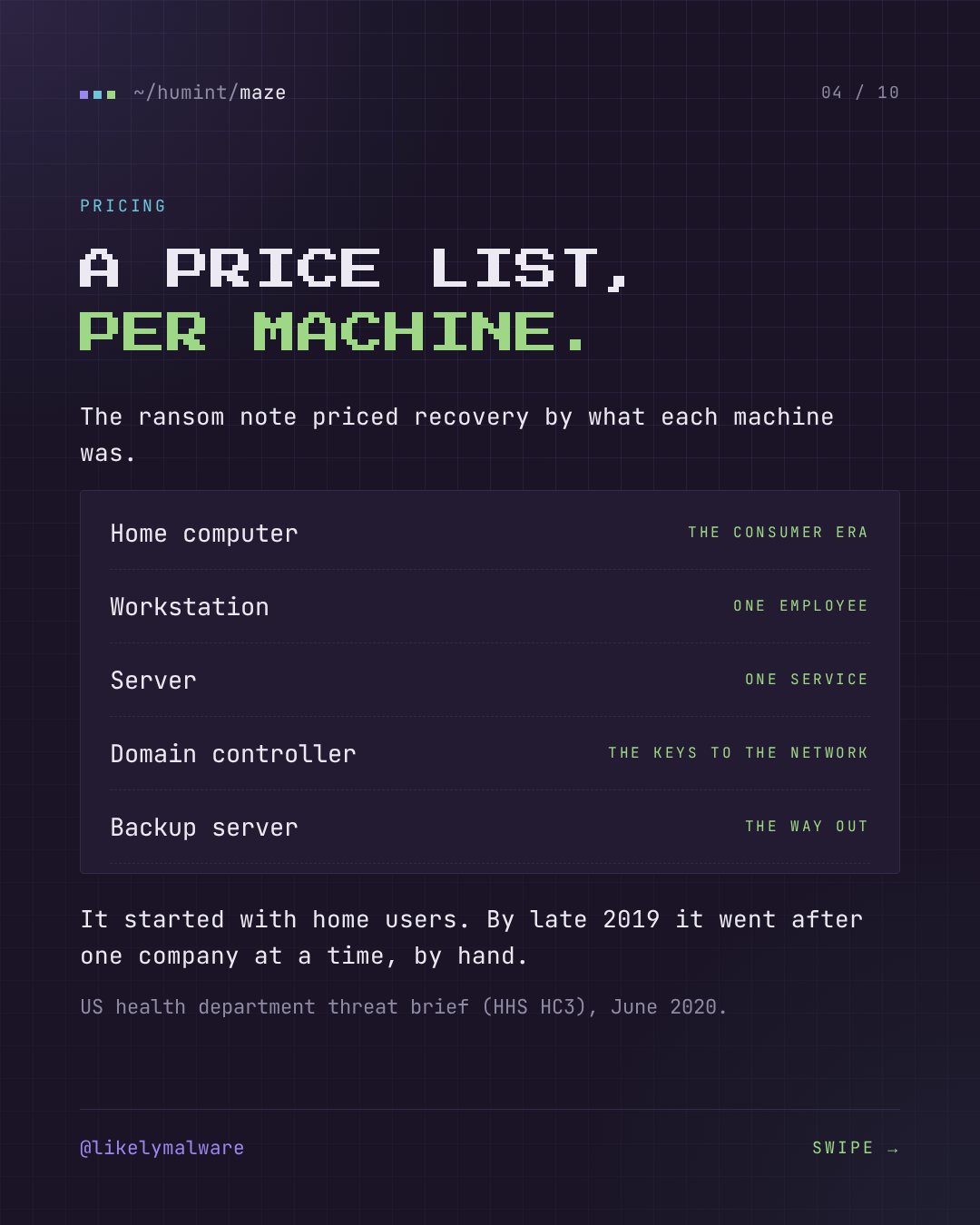
By the end of 2019 they had changed the business model. One victim at a time, hands on keyboard, with stolen credentials, VPN bugs and RDP (Remote Desktop Protocol) brute forcing. The ransom note even priced recovery by what the machine was: a home computer, a workstation, a server, a primary domain controller, a backup server. Somebody sat down and wrote a price list.
Friend of the Press?
Back to that email. The victim was Allied Universal, a security staffing company with about 200,000 employees and more than $7 billion in revenue. Maze said it had encrypted "a lot" of computers and wanted 300 bitcoin, about $2.3 million at the time. It also said, very openly, that it always steals the files before it encrypts them.
When BleepingComputer asked what guarantee a victim had that the data would be deleted after payment, the answer was a small corporate masterpiece:
"It is just a logic. If we disclose it who will believe us? It is not in our interest... We are neither espionage group nor any other type of APT, the data is not interesting for us."
So let me restate the offer the way they presented it. We are not interested in your data, and we delete it, it is just logic, and also we emailed a journalist about you, and we will run a spam campaign as you using your own email certificates, and we found the certificate password saved in a file called pw.txt, and we told the journalist about that too, with an "LMAO," and when the deadline passed we posted 700 MB of your files on the journalist's own forum, and then on a Russian hacking forum, and the other 90% goes to WikiLeaks unless the price goes up to $3.8 million. The data is not interesting for us at all.
According to Maze, Allied's best offer was $50,000. BleepingComputer refused to be used as a pressure tool, deleted the forum post, and only published the story on November 21st, 2019, once the files were already out.
Did Maze Invent Double Extortion?
They made it real, and the honest version is a little messier than the legend.
Crews had threatened to publish stolen data for years. In May 2019, a Twitter account tied to the RobbinHood ransomware posted what looked like City of Baltimore documents while the city was being squeezed, and some researchers date the practice from there. Maze was the first crew we know of that followed through in public, at scale, as policy. If you date it by infrastructure instead, the "Maze News" leak site came a few weeks later, in December 2019.
Pick the date by what you mean. I pick November 2019, because that is when the threat stopped being a bluff.
One more correction, because a version of it sits in a lot of retrospectives. Maze did not make backups worthless. Backups still bring your systems back. What a backup cannot do is pull 700 MB of your files back off a Russian forum. From that November on, a ransomware incident was also a data breach, and your restore plan had nothing to say about that half.
The Newsroom
Within weeks Maze had its own site, "Maze News." Victims who did not pay were listed with proof files, and journalists who followed the gang got "press releases." The December 2019 victims show the playbook.
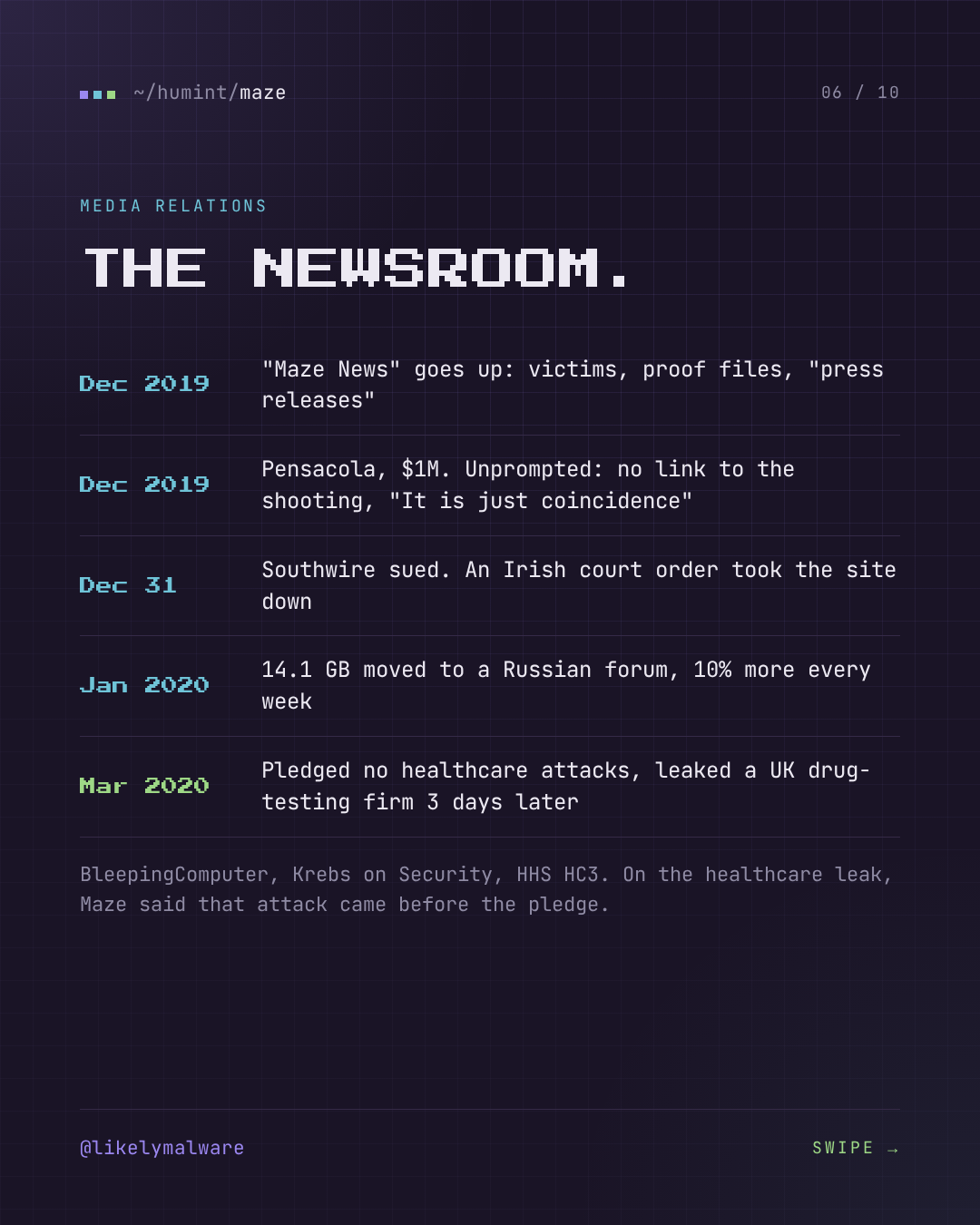
The City of Pensacola got a $1 million demand. Without being asked, Maze told BleepingComputer it had nothing to do with the shooting at NAS Pensacola just before the attack: "It is just coincidence." It also wanted it on the record that "no one of the socially significant services has suffered (for example 911)." That is a crew doing reputation management in the middle of an extortion.
Southwire, a wire and cable maker from Georgia, got an 850 bitcoin demand, about $6 million, after Maze stole 120 GB and encrypted 878 devices. Southwire did something nobody expected and sued. The site was hosted in Ireland, and an Irish court order on December 31st, 2019 took it down. Maze moved 14.1 GB of Southwire files to a Russian forum and promised another 10% every week. Sued, taken down, back on a forum within weeks, business as usual.
Then came COVID. On March 18th, 2020, Maze publicly pledged not to attack healthcare during the pandemic. On March 21st it published files from HMR, a UK drug-testing firm, and explained that the attack happened on March 14th, before the pledge, so technically it did not count. Plenty of real corporate comms teams have made that exact argument.
Some Respect Among Thieves?
In June 2020 Maze posted a victim it had never attacked. The files came from LockBit, a separate ransomware program that did not have its own leak site yet. Maze explained it to BleepingComputer like a partnerships manager: "We treat other groups as our partners, not as our competitors. Organizational questions is behind every successful business."
BleepingComputer called it a cartel. Ragnar Locker victims appeared on the site soon after, and Maze liked the word so much it started using "Maze Cartel" on its own leaks. By September 2020 Maze was even borrowing a Ragnar Locker trick, running its encryptor inside a virtual machine to hide from security tools.
Then a smaller crew called SunCrypt announced it had joined the cartel. Maze denied it: "we believe it is a PR strategy." A ransomware crew accused another ransomware crew of using its name for PR, and they were probably right.
Curtain Call
In October 2020 BleepingComputer heard rumours that Maze was shutting down and asked the crew to confirm. The answer was "You should wait for the press release."
Maze had stopped encrypting new victims in mid-September and was squeezing the last payments out of old ones. On November 2nd, 2020, the press release arrived, titled "The Project is closed." It said anyone using the Maze name was a scam, and then: "The Maze cartel was never exists and is not existing now. It can be found only inside the heads of the journalists who wrote about it."
They borrowed a word from journalists, wore it for five months, and handed it back in their farewell statement.
The code did not retire with the brand. Egregor started in mid-September 2020, exactly when Maze stopped encrypting, and Maze, Egregor and a third family called Sekhmet turned out to share the same code. Some Egregor victims who paid received a decryptor titled "Sekhmet Decryptor." Many Maze affiliates moved to Egregor, which is what affiliates do. They are free agents, and they go wherever the program is running.
In February 2022 a user called "Topleak" posted the master decryption keys for Maze, Egregor and Sekhmet on the BleepingComputer forums. Researchers confirmed they were real and a free decryptor followed. Even the final goodbye was posted where the journalists would see it.
What Came Out Since?
The tactic outlived the crew completely. Within weeks of Allied Universal, the REvil crew said on a forum that it would start naming and shaming too, and DoppelPaymer and Clop followed with their own leak sites. By June 2020 BleepingComputer counted thirteen active ransomware operations publishing stolen data. Today a leak site is just part of the kit, and some crews skip encryption entirely and run pure data theft extortion.
They Read the Papers Too
When you spend enough time watching and talking to these crews directly, the PR instinct is one of the first things you notice. They care how they are described, they correct reporters, and they want a name that sticks.
Maze turned that instinct into a business function. The ransom note was written for the IT team. The leak site and the press releases were written for everyone else: the board, the customers, the partners and the reporters. Maze studied journalists the same way we study them.
So here is the part worth taking back to your team. Ask two questions. How long does it take us to restore? And how long before we notice 100 GB leaving the network? If you only know the first number, you are defending against the 2018 version of this crime.
Maze closed "the project" six years ago, and every leak site running today still follows its playbook. New names show up every year, and the press releases keep coming, unfortunately.
I hope I was able to improve 0.1% of your knowledge. Have fun, and good luck!
Sources
- BleepingComputer, Allied Universal Breached by Maze Ransomware, Stolen Data Leaked, Nov 21 2019
- BleepingComputer, Maze Ransomware Behind Pensacola Cyberattack, $1M Ransom Demand, Dec 11 2019
- Krebs on Security, Ransomware Gangs Now Outing Victim Businesses That Don't Pay Up, Dec 2019
- BleepingComputer, Maze Ransomware Not Getting Paid, Leaks Data Left and Right, Jan 23 2020
- BleepingComputer, Drug testing firm sends data breach alerts after ransomware attack
- HHS HC3, Maze Ransomware threat brief, June 2020
- BleepingComputer, Ransomware gangs team up to form extortion cartel, June 2020
- BleepingComputer, Maze Ransomware adds Ragnar Locker to its extortion cartel, June 2020
- BleepingComputer, SunCrypt Ransomware sheds light on the Maze ransomware cartel, Aug 2020
- BleepingComputer, Maze ransomware is shutting down its cybercrime operation, Oct 29 2020
- BleepingComputer, Maze ransomware shuts down operations, denies creating cartel, Nov 2 2020
- BleepingComputer, Ransomware dev releases Egregor, Maze master decryption keys, Feb 9 2022
- StateScoop, Baltimore ransomware attack was early attempt at data extortion
- MITRE ATT&CK, Maze (S0449)